Showing posts with label Art. Show all posts

Wednesday, September 25, 2019

Frodo // A Character Sketch

(I wrote this as a guest post for the great LOTR read-along a few years ago. Thanks for letting me repost, Hamlette! :))


When first we hear of Frodo son of Drogo, he is an orphan. Brought up among the ‘queer Bucklanders’ and considered by many to be more than half a Brandybuck, he is being adopted by Bilbo as his future heir. Observant and clear-sighted, he is a lover of beauty, and also of maps and of elves, a ‘perky chap with a bright eye’ whom both Bilbo and Gandalf think the ‘best hobbit in the Shire.’


(Note, I still haven’t watched the movies, so I’ll be discussing all this as it appears in the books.)

With his rich inheritance comes the great and dreadful Ring. Gandalf had said of the Ring, in his first long discussion with Frodo near the beginning, ‘It is far more powerful than I ever dared to think at first, so powerful that in the end it would utterly overcome anyone of mortal race who possessed it. It would possess him.’ Of hobbits he said, ‘Among the Wise I am the only one that goes in for hobbit-lore: an obscure branch of knowledge, but full of surprises. Soft as butter they can be, and yet sometimes as tough as old tree-roots. I think it likely that some would resist the Rings far longer than most of the wise would believe.’


A bit farther on, Gollum’s name enters the conversation. At this point, if we’re picturing the Frodo we know from later, his first reaction may be a bit startling. ‘Gollum!’ cried Frodo. ‘Gollum? Do you mean that this is the very Gollum-creature that Bilbo met? How loathsome!’ ‘I think it is a sad story,’ said the wizard, ‘and it might have happened to others, even to some hobbits that I have known.’ ‘I can’t believe that Gollum was connected with hobbits, however distantly,’ said Frodo with some heat. ‘What an abominable notion!’ And farther still, ‘What am I to do? What a pity that Bilbo did not stab that vile creature, when he had a chance!’ ‘Pity? It was Pity that stayed his hand. Pity, and Mercy: not to strike without need.’ …‘I am sorry,’ said Frodo, ‘But I am frightened; and I do not feel any pity for Gollum.’ ‘You have not seen him,’ Gandalf broke in. ‘No, and I don’t want to,’ said Frodo, ‘I can’t understand you. Do you mean to say that you, and the Elves, have let him live on after all those horrible deeds? Now at any rate he is as bad as an Orc, and just an enemy. He deserves death.’

When he realizes what must be done about the Ring he says, ‘I do really wish to destroy it! …Or, well, to have it destroyed. I am not made for perilous quests. I wish I had never seen the Ring! Why did it come to me? Why was I chosen?’ Nevertheless, he sets out -- going through hard adventure and dread fear and frightful pain to Rivendell, and once there, voluntarily takes on the further horrific task.


He is called to a mission, a mission stressing with horrible intensity the very places where he most needs change, and -- shaped by grief and pain and the weight of his burden -- he does change. The Frodo who meets Gollum above the Dead Marshes is a very different Frodo from the Frodo at the beginning. Grown in wisdom, he has learned the place of mercy, and knows also that the dealing out of final judgment -- final doom -- is not his.


He has grown in wisdom and mercy, but at the same time, he is desperately fighting the growing power of the Ring. We see a lot of this through the eyes of dear, faithful Sam. As, in torment and travail, they near Mount Doom, Sam ‘guessed that among all their pains he (Frodo) bore the worst, the growing weight of the Ring, a burden on the body and a torment to his mind.’ Twice, he tries to fight Sam off. The second time, ‘A wild light came into Frodo’s eyes. ‘Stand away! Don’t touch me!’ he cried. ‘It is mine, I say. Be off!’ His hand strayed to his sword-hilt. But then quickly his voice changed. ‘No, no, Sam,’ he said sadly. ‘But you must understand. It is my burden, and no one else can bear it. It is too late now, Sam dear. You can’t help me in that way again. I am almost in its power now. I could not give it up, and if you tried to take it I should go mad.’


So we come to Mount Doom -- and to his claiming of the Ring and the final reappearance of Gollum. Frankly, this part always bothered me until recently. But lately, I’ve begun to see just how exciting it is. First off, if Frodo had somehow managed to drop the Ring into the fire himself (as well as trivializing the danger) we would have much more of a straight-forward allegorical tale with him as the central Christological figure. Instead, we have (at least) two other major Christ-type figures, with all of them together contributing to a much fuller, richer glimpse and a tale of marvelous depth and complexity.


Second: initially, Frodo was sent on an almost hopeless errand, not knowing (if he even reached the mountain) how he would ever gain the strength and will-power to destroy the Ring. Yet the conflict isn’t resolved by deux ex machina, either. Gollum was shown mercy over and over again -- by Bilbo, Aragorn, Gandalf, Frodo, Sam, and even Faramir -- all with the idea that he had yet a purpose to fulfill and offering further opportunity for repentance. He was under oath to both Frodo and Faramir against treachery. ‘Then I say to you,’ said Faramir, turning to Gollum, ‘you are under doom of death; but while you walk with Frodo you are safe for our part. Yet if ever you be found by any man of Gondor astray without him, the doom shall fall. And may death find you swiftly, within Gondor or without, if you do not well serve him.’ Frodo had earlier warned him that a similar oath on the Ring would twist him to destruction.


So the mission incredibly succeeds -- succeeds as themes of wisdom and mercy flash brilliantly into focus, and a divine, overarching doom falls. From Sam again, ‘Well, this is the end, Sam Gamgee,’ said a voice by his side. And there was Frodo, pale and worn, and yet himself again, and in his eyes there was a peace now, neither strain of will, nor madness, nor any fear. His burden was taken away. There was the dear master of the sweet days in the Shire. ‘Master!’ cried Sam, and fell upon his knees. In all that ruin of the world for the moment he felt only joy, great joy. The burden was gone. His master had been saved; he was himself again, he was free.’


Here we come to a really interesting point. Frodo had to be saved. Now again in some ways (his burden-bearing for others, the royal temptations he faces, the pain and the anguish, the knife-wound, and the chilling, torturing, death-like experiences, etc.), Frodo can definitely be seen as a Christ-type figure. But -- while all that is absolutely true -- I think it equally true that he could just as well be a picture of us. I’ve also come to the conclusion that, of any of the characters within the story, he might actually best be compared to Boromir. Both are strong and honorable yet stumble at the same temptation, both are saved by grace and repentance (also seeing their actions clearly), and both are treated afterwards as being no less worthy of all honor and respect. And both see something through all the way to the end of their road, though death (in metaphor or reality) lies at the end of it.


Finally, on the slopes of Orodruin, surrounded by spewing flames and shattering earth, Frodo (and Sam) lie prostrate, starving and thirsting. And against all hope they are saved. The eagles come, bearing Gandalf, and they are brought out of fire and death and the tumult of destruction. Awaking in a place of dappled sunlight and cool green shade, they find themselves in the garden of Gondor and in the keeping of the King -- of the King who has tended and saved them -- of the King whose crown Frodo later bears.


Frodo, a richly adopted heir is, in the fullness of time, given and called to a task. A humble being, fighting and winning and losing against temptation (and yet succeeding because of the wisdom and mercy he has learned), he is led by his calling on a path of sufferings and death and darkness. And he is brought out again to glory -- to light and to joy, to a place of fresh raiment and song. Brought with a multitude of others to a place of piercing joy, to ‘regions where pain and delight flow together and tears are the very wine of blessedness.’ And to a place where -- crowned with circlets of silver -- he and Sam are led with high praise to seats of honor at the King’s table.

~     ~     ~

Thanks for reading -- I'd love to hear your thoughts. :) And again, be sure to check out all the other lovely posts at The Edge of the Precipice!

Monday, September 23, 2019

Faramir // A Character Sketch


It's the 7th Annual Tolkien Week over at Hamlette's The Edge of the Precipice -- YAY! So excited!! 

Note: I first wrote this as a guest post during one of Hamlette's read-alongs a few years ago and she kindly let me repost here for the party. Enjoy and looking forward to hearing your thoughts! (P.S. Most of the pictures in this post are by some talented computer artists courtesy of Google. Make sure to right click on them to see the title and artist. Also, YES. I know it's not the Hobbit here and there aren't any dragons as such in LOTR, but I loved the colors of all these and thought they captured the fear of the Nazgul. So just forestalling any objections. ;D)
~     ~     ~


Faramir... I can still remember piecing together who this ‘grave young man’ was ‘whose words seemed so wise and fair’ as my father was reading The Lord of the Rings aloud for the first time (that I can remember, that is). I must have been about eight and I can still remember the thrill when I realized he and Boromir were related.

So many people like Faramir, but what makes him such a wonderful character? (Second note: I haven’t watched the movie, so in the following I’ll be discussing him as he appears in the book.)


When first we meet him in Ithilien, he is both rough and commanding, but his courtesy is soon set beyond a doubt. When interrogating Frodo (much to Sam’s displeasure) he is ‘stern and commanding’ with ‘a keen wit behind a searching glance.’ He says, ‘I do not slay man or beast needlessly, and not gladly even when it is needed. Neither do I talk in vain.’ A man taking time for thought, refusing to act in haste, he is quick and decisive in action. ‘I will not decide in haste what is to be done. Yet we must move hence without more delay.’ He sprang to his feet and issued some orders.’


Weighing his words, he is a truth-teller, ‘I would not snare even an orc with a falsehood.’ He doesn't immediately let out all he knows -- parrying and questioning Frodo before telling what he himself already knew of Boromir -- guarding his words when speaking with his father -- waiting -- knowing what to speak when the time comes ripe; revealing the better part of wisdom.


Faramir seems to have the ‘long-sight’ associated with the blood of Westernesse, for Gandalf says of Denethor, ‘Whatever be his descent from father to son, by some chance the blood of Westernesse runs nearly true in him; as it does in his other son, Faramir... He has long sight. He can perceive, if he bends his will thither, much of what is passing in the minds of men... It is difficult to deceive him, and dangerous to try.’ Earlier, in the cave of Henneth Annûn, ‘Slowly Gollum raised his eyes and looked unwillingly into Faramir’s. All light went out of them, and they stared bleak and pale for a moment into the clear unwavering eyes of the man of Gondor...‘There are locked doors and closed windows in your mind, and dark rooms behind them,’ said Faramir. ‘But in this I judge that you speak the truth.’ Later, first encountering Éowyn, ‘...he was moved with pity, for he saw that she was hurt, and his clear sight perceived her sorrow and unrest.’

Gentle and yet stern, he is patient and long-suffering with the wayward and headstrong -- Boromir, Éowyn, his father. Amazing in how it’s done (especially as it’s understated -- and in Boromir’s case we never see them together), but we never doubt his great love for both father and brother.


A courageous leader, his men give him their love and trust. Beregond says of him, ‘Things may change when Faramir returns. He is bold, more bold than many deem; for in these days men are slow to believe that a captain can be wise and learned in the scrolls of lore and song, as he is, and yet a man of hardihood and swift judgment in the field.’ Éowyn ‘looked at him and saw the grave tenderness in his eyes, and yet knew, for she was bred among men of war, that here was one whom no Rider of the Mark would outmatch in battle.’


In the cave of Henneth Annûn, when the Ring itself comes within his grasp, he withstands its lure, saying, ‘I am wise enough to know that there are some perils from which a man must flee.’ Later Sam says, ‘You took the chance, sir.’ ‘Did I so?’ said Faramir. ‘Yes sir, and showed your quality: the very highest.’ Faramir smiled, ‘...Yet there was naught in this to praise. I had no lure or desire to do other than I have done.’ Perhaps, at first glance, a little disappointing -- we might like him to have more of an internal battle before relinquishing his opportunity -- but in fact, evidence of the highest quality indeed. Authority sits easily on him, but he does not desire ultimate power. He does not desire it because -- above all -- he is a valorous servant.


In his valor and courage, he yet knows weakness and grief. As he lies near death, Aragorn reads his hurt as, ‘Weariness, grief for his father’s mood, a wound, and over all the Black Breath... He is a man of staunch will, for already he had come close under the Shadow before ever he rode to battle on the out-walls. Slowly the dark must have crept on him, even as he fought and strove to hold his outpost.’


Captain of the White Tower -- Steward of Gondor -- a servant of the king and passing through death in his service -- he is healed and brought back to life by that King. ‘Suddenly Faramir stirred... and he looked on Aragorn who bent over him; and a light of knowledge and love was kindled in his eyes, and he spoke softly. ‘My lord, you called me. I come. What does the king command?’ ‘Walk no more in the shadows, but awake!’ said Aragorn, ‘You are weary. Rest a while, and take food, and be ready when I return.’ ‘I will, lord,’ said Faramir. ‘For who would lie idle when the king has returned?’


Joy, obedience, and valorous service... A wise and daring servant, he is exalted in honor. May we strive to live likewise with the same end in view -- the heart-fulfilling, soul-satisfying commendation of our King.

~     ~     ~


More coming later in the week and be sure to check out the party and the rest of the entries over on Hamlette's blog!

Tuesday, September 22, 2015

Movie Review ~ Ever After with Drew Barrymore and Dougray Scott (1998)


The time has finally come for reviewing one of my top favorite movies of all time. I’ve been planning this for quite a while, but as I was working on it I realized just how much I love its late summer/early autumn setting, making this a perfectly opportune time!


And now—with that pre-ramble out of the way—our Ever After post! (Possibly to be known also hereafter as screen cap overdose. ;D)


First off, Ever After has it all: a rich, satisfying wealth of adventure, beauty, humor, character development, masterful storytelling, and poignant, beautiful, twist-your-heartstrings romance. And then there are the gorgeous settings and music! The sixteenth century springs to life with all its breathtaking brilliance, clarity, and exuberance.


I want you to vividly experience the intensity and turns of the story for yourself, so in the following (with great self-restraint) I’m going to try and not give too many spoilers. 


However, there are a number of rumblings (vague content rumors and so forth) flying here and there, which is why it initially took me quite a while to see it, not being able to decide what exactly was up with it content-wise. So what I am going to do, is hopefully share the kind of particulars I personally would have found super helpful when trying to make up my mind. (To paraphrase Uncle Max, detailing “every last eensy-teensy frightful little detail.”)


First for some of the misconceptions. The biggest of these I had upon reading the advertising was that Danielle (i.e. Cinderella) was an independent, very modern, sixteenth century feminist. She’s nothing of the kind.


Well educated, strong in her own beliefs, feisty and spirited, yet equally gentle and soft-spoken, showing both honor and respect to the end, she’s absolutely beautiful! (More on her later.)


The second comes from the summary floating around saying something along the lines of “having the courage to make your dreams come true.” From that I got the impression (again) that it would be one of those “follow your heart at the expense of everyone and everything else” type stories. I am going to give a few spoilers on this one below, but let me assure you here and now—it isn’t. Not remotely. (Don’t you love it when the advertisers try to create a blaze? The same thing happened with my copy of N&S.)


Next for the ‘content’ stuff. As aforementioned, it’s robustly in period—permeated to the hilt with rich Renaissance/late-medieval atmosphere. In other words, it’s not Victorian. 


Some period idioms are used (i.e. “tub of guts,” for instance) and That Certain Exclamation is used a couple times (for reference, about as much as the ‘95 P&P and in similar context). There are a few innuendos in the market scene wherein Pierre Le Pieu first appears. And there’s one incident with a page near the end (where I think he’s caught attending to some personal business), but it’s NOT overt and really and truly, decidedly un-obvious. Absolutely nothing is shown. Earlier, a lady’s shoulder is shown as she’s slipping on a gown and later her upper back is shown after a whipping. Chamber pots are referenced and emptied out windows.


But please take my word for all this. Really. None of this content is more ‘iffy’ than some stuff in (for another familiar instance) Little Dorrit. In fact, much, much less so. I’m just detailing every last thing I can possibly think of to give as clear and persuasive a picture as possible. :)


Now on to the squeal-worthy part! And here I have to share some trivia facts too delightful to pass up.


#1: The story opens with the brothers Grimm calling on a nineteenth century French queen in her absolutely sumptuous rooms and fact #1 is something I only just noticed when working on this review. Have you ever noticed (those of you who have already seen this) that her bed is Leonardo’s ship from the masquerade ball?


#2: Incredibly (of all his work) it’s one of my two favorite Da Vinci paintings running through the entire story—fitting it with amazing perfection!


#3: I recently found an official movie ranking site had compiled a list of their favorite Cinderella adaptations this spring, reading from bottom to top. I didn’t recognize a lot at first and as I was scrolling I started going, “Oh… Ever After isn’t even getting mentioned in passing.” Based on some of the other variations they had, it seemed like it should at least have made the list. I was getting ruffled, but since (technically) it is a bit of a different take on the story I tried to remain calm and kept scrolling down.


The 2015 Cinderella came up as #2 and I thought, “That’s wild. I wonder what version they can possibly pick for #1?” Trying to will away the butterflies and starting to get excited as whatever-it-was would probably be worth seeing if it topped the 2015 Cinderella, I scrolled one last time and… guess what it was?!?! Yes! Absolutely! Ever After!!!! To say I’m still ecstatic would be an understatement. :)


This is probably the first film I’ve ever seen where I thought every single person (major and minor characters) were utterly and perfectly cast. 


There are a number of familiar faces, including Judy Parfitt (whom I’d seen all my growing up in the 80’s P&P as Lady Catherine and then later in Little Dorrit) playing the prince’s mother. And I love her in the part! It’s definitely my favorite of her roles. She’s so warm and gracious and regal!


And… we got all the way through before we realized we’d seen Dougray Scott (Prince Henry) in the Zorro tv show of all exciting wonders! He’s much younger in Zorro, but it’s especially funny as he has a roughly similar character arc—just about seven years earlier.

But now for the rest of the casting:


The young Danielle does excellently and her relationship with her father is absolute perfection.


There are the dear servants.


And Gustave.


Leonardo da Vinci

(“Then you learn to pay attention.”)


The Baroness Rodmilla de Ghent (Danielle’s stepmother).

(“She’s mute, my lord.”)


Marguerite, the nasty stepsister.


And Jacqueline who is SO sweet (with some of the most quote-adaptable comebacks)!


There’s the king (I love how his character changes—I wasn’t expecting it!)


The captain of the guard.


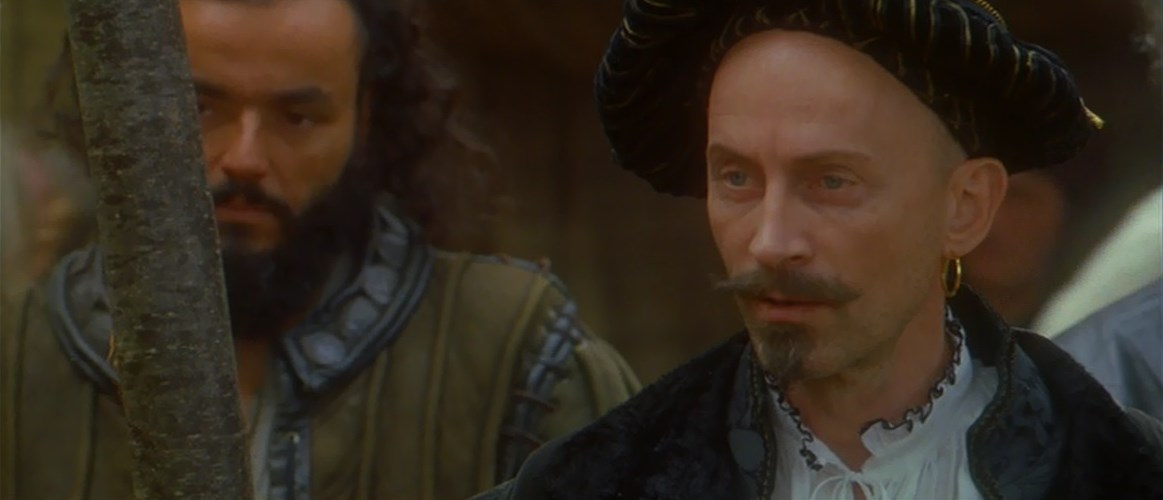
And the de Ghent household’s “benefactor”, Pierre Le Pieu, who is appropriately wicked and creepy.


And of course, the gypsies…


But first and foremost, there’s Danielle de Barbarac and Prince Henry.


During and throughout their various adventures together in river and wood, he treats her with such perfect and thorough respect and honor.


His character arc is incredible.


He becomes a man. And looking back over that arc, the depth and balance of the oft-times conflicting growth within it is astounding.


And there is Danielle herself. 


Sometimes it’s easy to lose sight of what true beauty looks like. Courageous strength to risk oneself for a loved one—to say the hard words when called upon—is not incompatible with true femininity.  They’re inseparable qualities. Gentleness and grace with fierce loyalty. A clarity of vision and steadfastness of soul. The beauty of a gem wrought—fashioned—bent and shaped to glory through duress and pain, shining even in the darkness with the radiant light lying always at its heart.


Vibrant and pulsating with the potent reality of life, Ever After is a story of grace on the undeserving. The adventure of life is worth every pain—and the weight of glory on the other side is immense.


“While Cinderella and her prince did live happily ever after—the point, gentlemen, is that they lived.”

(And I’m sorry, this one’s blurry, but oh… the joy of it!!!)

 
In conclusion (and to borrow a phrase from my sister), it’s one of my greatest heart stories—true, good, beautiful, poignant, heady, glory-reflecting story—and I love it hard!

Tell me! Have you seen Ever After? What do you think?


Related Posts Plugin for WordPress, Blogger...