Showing posts with label Living as a Heroine. Show all posts

Monday, October 12, 2020

Inklings // October 2020

Annnnnnd.... it's time for our October Inklings! For more see the first post here or the rules below.

Rules:

1. At any time during the month, on your own blog post a scene from a book or film that matches the prompt, including a link back here in your post.

2. Leave a link to your post in the comments section on this post and I'll post all your links with the next prompt. That's it!

September Round-Up:


~

And October's prompt is:

A scene that shouts 'autumn' to you in book or film

My contribution is from one of my top heart stories of all time: Song of the Voyageur by Beverly Butler. (Forgive any choppiness; it's longer in full/I had to do highlights from the scene.)

"Whether it was the charm of his smile that influenced her or the crisp rustle of leaves underfoot or the dry, dusty smell of them in the hazy air, she soon found it difficult to do anything but enjoy herself. Nathan was in high good spirits, full of ridiculous comments and nonsensical observations on everything that struck his fancy, so that by the time they reached the summit of the bluff, they were as breathless from laughter as from the sharpness of the ascent. They paused only a moment to rest, though, before he led her on along the leveler ground in the general direction of the lake shore. 

“Here we are,” he announced at last with a flourish as they came out on a sunny, rocky point. “This is what I wanted to show you.” 

She uttered a quick exclamation of pleasure at the scene so suddenly spread before her. At her feet, a cascade of red and gold fell away to the foot of the bluff, while straight ahead and on either side, as far as she could see, stretched the lake, its peaceful waters reflecting the intense but fragile blue of the Indian summer sky. 

“Do you know what's beyond that?” Nathan asked, gesturing eastward toward the misty blending of sky and water. 

She smiled. “Michigan territory?” 

“Then Lake Erie—Pennsylvania—and Philadelphia.” The flippant quality had vanished from his voice. “Only a week more or less and we'll be on a boat in the middle of this lake, on our way back to Mackinac and then to civilization.” 

“We?” She turned a surprised face from the lake to him. 

“Of course, we! You didn't think I'd leave you behind a second time, did you?” ...“I told you I would be back for you within the year,” he said, drawing a step nearer. “Does it make such an important difference that I've come now, instead of waiting for the spring?” 

"She colored faintly and looked away, thrusting from her mind the memory of someone else who had once promised to come back in the spring. “A week is so short! It wouldn't be—it isn’t possible to leave just like that. Don't you see?"

...From a limb above her, a scarlet leaf fluttered free to touch her hair, her cheek, her shoulder, and to flame a second against the deep blue of her skirt before she caught it and said softly, “It wasn't the packing I was thinking of so much as of leaving everyone—André, the boys, Lisabette—” 

...The toe of his polished boot sent a spray of brown and russet tumbling about his ankles. ...“At least I understand this,” he said eagerly, holding his open hand toward her and letting his voice sink into the persuasive cadences that made it most musical. “This country with its bears and blood and doing without is no place for you. Philadelphia was meant for you. After a month or two there as my wife, you'd be the queen of the city, part of the finest society. You couldn't help but be!” 

She was turning the maple leaf over and over in her fingers, as though by the red symmetry of its jagged edges or its waxen smoothness she could read the counsel she needed. “Only a week.” ...She cast a longing glance across the expanse of glistening water before her eyes rested again on the bright leaf and she turned away. “You make it so hard.” 

“It needn't be hard,” he said, stooping even closer in the pretense of trying to glimpse her averted face. “You have but to say yes.” 

Abstractedly, she wove the supple leaf stem in and out of her fingers, her thoughts in confusion. ...She knew well enough what kept her from answering: it was a foolish thing, but possessed of the exaggerated proportions foolish things so often have. Yesterday, and for a while today, too, she had let herself imagine it was Nathan who could dispel the cloud of half-melancholy discontent that had haunted her throughout the summer; but somehow he had failed her. It was as though she had been a little girl, full of shining conjectures about the contents of a promised box, only to discover on opening it that it contained nothing at all. What she had hoped to find, she could not tell, but she knew that it was something wonderful—something she must have had somewhere before, and lost. 

She looked down at the leaf she held, and opening her fingers, let it slip between them and drift to the ground. “I can’t decide now.” 

“Listen to me, Diane!” he cried, stung by her disregard of his wishes. “How long do you think you can play this game of hide-and-seek and still keep me waiting patiently? You must decide now, and neither of us is leaving this place until I have my answer!” 

...His temper was rising... He seized her arm and pulled her closer, as though he meant to carry her off with him by sheer strength, and fear quivered through her again, as it had that day beside the stone chimney. 

“This evening—” she begged.

...He cut her short. “You've put me off too many times before, and I've waited for you longer than I've ever bothered to wait for any other person. My patience is at an end! Answer me now!” 

Angry pride held her rigid in his grasp. Summoning all the dignity at her command, she raised a face to him as outwardly cool and collected as inwardly she was seething. “If I do, the answer will be no!” 

He could not have looked more stunned if she had suddenly lashed a whip across his face. Dropping her arm, he fell back a pace, the anger in his eyes changing to wonder, to belief, to conciliation. “Diane, let me explain! It’s only that—” 

But her ears, more attuned to the woods than his, had caught a sound beyond his voice—and all else was forgotten. “Listen!” 

He stared at her as she stood alert, straining to hear each one of the distant notes, and a black cloud settled over his features as his eyes, almost before his ears, told him the reason for her eager attention. “A trapper’s probably bringing his furs to the post, that's all. That song is as common as Yankee Doodle out here, and any Frenchman can sing it!” 

“Any Frenchman, yes,” she said, “but not like that! There's only one!” She evaded the arm he put out to stop her, and he was not swift enough to bar her path. Like a leaf snatched by an autumn wind, she sped back along the way they had come, toward the river and the post and the singing."

from Song of the Voyageur by Beverly Butler

Who else thinks we should try to find whomever knows anything about this and try to get it back in print? 


Looking forward to seeing what you all come up with! Have fun!

Wednesday, September 23, 2020

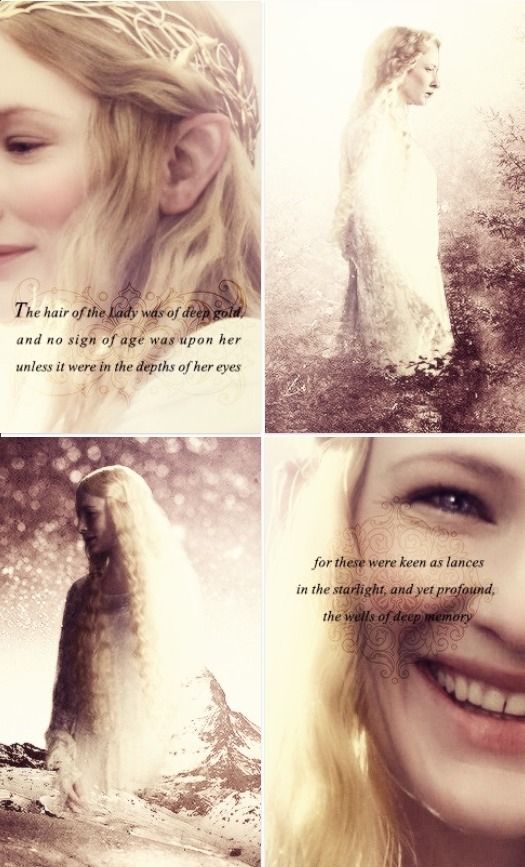
Queenly Dignity, Honor, Strength & Beauty // Galadriel, Éowyn & Arwen in Lord of the Rings


J.R.R. Tolkien was not fond of allegory. To put it mildly. He went on record on the subject multiple times, but this is a pretty clear quote from his introduction to the second edition of LOTR: “As for any inner meaning or ‘message,’ it has in the intention of the author none. It is neither allegorical nor topical. ...I cordially dislike allegory in all its manifestations, and always have done so since I grew old and wary enough to detect its presence." 

At the same time, his Christian faith was the core of his being and he said: “(The Lord of the Rings) is of course a fundamentally religious and Catholic work; unconsciously so at first, but consciously in the revision. That is why I have not put in, or have cut out practically all references to anything like 'religion,' to cults or practices, in the imaginary world. For the religious element is absorbed into the story and symbolism.” 

God made the world a certain way, His fingerprints are all over it. He’s weaving the magnificent tapestry of redemption and if an author is being honest and writing what is true -- writing the way things are -- certain themes and patterns are also going to emerge (cue my fascination with Conrad’s Heart of Darkness, but that’s a discussion for another day). And this is all especially true when we get down to deep myth. Which, of course, is Tolkien’s specialty.

Ok, with that understanding, the Christological imagery in LOTR of Prophet, Priest, and King (which generally pair most prominently with Gandalf, Frodo, and Aragorn respectively) is well established. And Tolkien’s devotion to the Roman Catholic Mariology doctrines and how it might relate to the lady figures of LOTR (with, apparently, some debate as to how exactly it would all parcel out) is fairly well known in certain circles. But when I was looking into this (while finding lots of quotes from Tolkien on Mary and lots of writing from other people linking it with LOTR), I couldn’t find anything (online anyway) from Tolkien himself directly tying the two together. (Which, y’know, we wouldn’t expect anyway given what he said above.) 


A lot of people have also put forth a lot of details on character pairing. If you look it up at all, there are differing levels of far-fetchedness, illumination, and/or simplicity to them (i.e. Galadriel v. Shelob etc., which I ran across while researching this). Part of the trouble (or rather the wonder of it) is that Tolkien did such a masterful job embodying the themes in each and every character -- exploring different facets and angles (and EVERYTHING ties back, without being redundant, but adding further depth and complexity) -- so that you can contrast pretty much any character with another character.

Thinking about the prophet, priest, and king roles, though, I’ve been pondering a lot about the possible pairing reflections of Gandalf / Galadriel, Aragorn / Arwen, and Frodo / Éowyn.

It has also been posited that Tolkien tied in the Greek (and indeed widespread ancient) understanding of the elements (fire, earth, air/wind, and water, and which were often closely tied with various gods) in the personas of (from what I can piece together) Arwen (fire), Galadriel (earth), Éowyn (air/wind), and Goldberry (water). Deep myth and imagery-wise + with Tolkien’s background in ancient and medieval history, there might be something to this, but here I’ll be focusing more on the first theory (or rather, because I’m Protestant, tendering my own thoughts on it). 


Ok, so here’s where we get into a little choppy water, but it seems necessary. As a Protestant, I deeply respect and look up to Mary as a faithful saint who was the recipient of great and incredible blessing and honor, but I do take serious issue with Tolkien in this regard. That said... I'm actually not going there today. We'll stay in Middle Earth. (I only mention it at all in hopes of showing I've been carefully studying what Tolkien himself says on the subject in order the better to respect his thought process and avoid jumping to conclusions willy nilly.)

For the sake of this post and brevity, I'll just say we would put the emphasis on Mother Kirk, the church, who -- saved and washed down through the ages by the blood of Christ -- will one day stand beside Him, crowned in all glory and honor, and in dazzling white for all the world to see.

Following all of which, if we believe certain Biblical themes and truths run through creation and if the Bible has much to say (also in types and shadows by times) on the labor and rejoicing of queenly women, then there’s a vast depth here to think about. (Clarification: I've included a few verses in the following, but I'm *not* expounding them, merely including them to highlight the deep alliteration of ideas and imagery.)

Which brings us AT LAST, to the grace, strength, and beauty of Galadriel, Arwen, and Éowyn. <3

“She girds herself with strength, and strengthens her arms. … her lamp does not go out by night. She extends her hand to the poor, yes, she reaches out her hands to the needy. Strength and honor are her clothing; she shall rejoice in time to come.” Proverbs 31


~ Galadriel ~ 

“…Sam was now standing beside him, looking round with a puzzled expression, and rubbing his eyes as if he was not sure that he was awake. 'It’s sunlight and bright day, right enough,’ he said. 'I thought that Elves were all for moon and stars: but this is more elvish than anything I ever heard tell of. I feel as if I was inside a song, if you take my meaning.’ Haldir looked at them, and he seemed indeed to take the meaning of both thought and word. He smiled. ‘You feel the power of the Lady of the Galadhrim,’ he said.” The Fellowship of the Ring

Galadriel // striving against the Enemy and holding back the darkness // dispensing good and precious gifts for the road ahead

A glorious golden light beyond the ken of mere mortals. Fierce and mysterious yet a refuge, a city set on a hill. A lofty lady of long ages. 
On her tongue wise words, dripping like aged wine. 

“Who is she who looks forth as the morning, fair as the moon, clear as the sun, awesome as an army with banners?” The Song of Solomon

“Do not be afraid! But do not think that only by singing amid the trees, nor even by the slender arrows of elven-bows, is this land of Lothlórien maintained and defended against its Enemy. …even as I speak to you, I perceive the Dark Lord and know his mind… And he gropes ever to see me and my thought. But still the door is closed!” She lifted up her white arms, and spread out her hands towards the East in a gesture of rejection and denial.”

“…from the ring that she wore there issued a great light that illumined her alone and left all else dark. She stood before Frodo seeming now tall beyond measurement, and beautiful beyond enduring, terrible and worshipful. Then she let her hand fall, and the light faded, and suddenly she laughed again, and lo! she was shrunken: a slender elf-woman, clad in simple white, whose gentle voice was soft and sad.” The Fellowship of the Ring

~ Arwen ~ 

“Young she was and yet not so. The braids of her dark hair were touched by no frost… and the light of stars was in her bright eyes, grey as a cloudless night; yet queenly she looked, and thought and knowledge were in her glance, as of one who has known many things that the years bring. Above her brow her head was covered with a cap of silver lace netted with small gems, glittering white; but her soft grey raiment had no ornament save a girdle of leaves wrought in silver. So it was that Frodo saw her whom few mortals had yet seen; Arwen, daughter of Elrond, in whom it was said that the likeness of Lúthien had come on earth again; and she was called Undómiel, for she was the Evenstar of her people.” The Fellowship of the Ring

Arwen // Evenstar 
// lady of white gems and starlight 
// the reward to be won

Patient and enduring, looking for things not yet seen. 

Regal and gracious, standing finally beside her triumphant Lord and King.


Crowned Queen and following him through sacrifice, and the still enduring death that is in the mortal world. 

And trusting through long years in the promised one to whom she has pledged herself, while fashioning the standard which will be a banner to the peoples. 

“…lo! even as he laughed at despair he looked out again on the black ships, and he lifted up his sword to defy them. And then wonder took him, and a great joy; and he cast his sword up in the sunlight and sang as he caught it. And all eyes followed his gaze, and behold! upon the foremost ship a great standard broke …There flowered a White Tree, and that was for Gondor; but Seven Stars were about it, and a high crown above it, the signs of Elendil that no lord had borne for years beyond count. And the stars flamed in the sunlight, for they were wrought of gems by Arwen daughter of Elrond; and the crown was bright in the morning, for it was wrought of mithril and gold.” The Return of the King

~ Éowyn ~ 

“Grave and thoughtful was her glance, as she looked on the king with cool pity in her eyes. Very fair was her face, and her long hair was like a river of gold. Slender and tall she was in her white robe girt with silver; but strong she seemed and stern as steel, a daughter of kings. Thus Aragorn for the first time in the full light of day beheld Éowyn, lady of Rohan, and thought her fair, fair and cold, like a morning of pale spring that is not yet come to womanhood.” The Two Towers

Éowyn // the White Lady 
// loyal, valorous, and true hearted 
// crushing the head of the serpent 

“Most blessed among women is Jael… She stretched her hand to the tent peg, her right hand to the workmen’s hammer; she pounded Sisera, she pierced his head… At her feet he sank, he fell; where he sank, there he fell dead.” Judges


Like Frodo, dearly loving her guardian figure, willing to dare all and die in his stead; battling the King’s enemies even when the darkness seems greatest and the gates of hell bar the way; going through the deep shadows, bearing much pain and sorrow and growing despair, yet -- healed by the hand of the King -- emerging at last, triumphant, into the light.

“For you are a lady high and valiant and have your­self won renown that shall not be for­got­ten; and you are a lady beau­ti­ful, I deem, be­yond even the words of the El­ven-tongue to tell.”

“Then the heart of Éowyn changed, or else at last she un­der­stood it. And sud­denly her win­ter passed, and the sun shone on her. 

‘I stand in Minas Anor, the Tower of the Sun,’ she said; ‘and be­hold the Shadow has de­parted! I will be a shield­maiden no longer, nor vie with the great Rid­ers, nor take joy only in the songs of slay­ing. I will be a healer, and love all things that grow and are not bar­ren.” The Return of the King

Galadriel, Éowyn, and Arwen each fighting the serpent in their particular corner of the battlefield, laboring in travail, fighting even when hope is dim, and coming out in the end to great victory. 

To hearken back to the beginning, we don’t view any of Tolkien’s characters as cardboard figures (each with a tidy allegorical lesson and homework for us to apply). No, for deep truth and beauty is far deeper -- wilder -- uncontained. Dangerous. For in deep story -- true myth -- as we catch flashes and glimpses and reflections of deep truth and beauty -- that beauty itself can help shape and point us to our one and only Savior, the Fountainhead of all breathtaking glory and goodness and beauty and heart-stopping joy. 


This was written for Hamlette's Tolkien Week. I hope you enjoyed and I'd love to hear your thoughts! <3

Wednesday, March 15, 2017

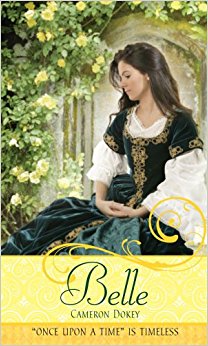
Book Review // Belle by Cameron Dokey


"My mother sat beside Papa, an arm around his waist as if to shore him up. "Drink your tea, Roger," she urged in a soft, firm voice. "You got caught in that rain squall this morning, didn't you? The tea will warm you up." My father took a sip, obediently, like a child. "I'm sorry to be such trouble," he said. "Papa," I said, shocked. "How can you talk so? We love you. How can anything we do for you trouble us?" The mug of tea slipped from my father's fingers, then bounced off the tabletop and smashed on the floor. Hot liquid and broken crockery shot every which way. None of us moved or made a sound. Our attention was riveted on my father's face, on the tortured expression in his eyes as they stared into mine. "Belle," my father said hoarsely, and I felt the hairs on the back of my neck rise at his tone. "Ma petite Belle. I wonder if you will say that when you know what I have done." (excerpt)


"Belle is convinced she has the wrong name, as she lacks her sisters' awe-inspiring beauty. So she withdraws from society, devoting her time to wood carving. Secretly, Belle longs to find the fabled Heartwood Tree. If carved by the right hands, the Heartwood will reveal the face of one's true love.

"During a fierce storm, Belle's father stumbles upon the mysterious Heartwood -- and encounters a terrifying and lonely Beast. Now Belle must carve the Heartwood to save her father, and learn to see not with the eyes of her mind, but with the eyes of her heart." (summary)


I read this book all in one sitting early this week and quite relished it. Well over half the book actually takes place well before the Beast ever enters in, but for all that, it included some of my favorite parts. I really enjoyed Dokey's spin on Belle's family: with the caring parents and the realistic relationship between the sisters -- bickering sometimes, but genuinely loving one another hard even in the toughest times.


Her descriptions are delicious, and round various little twists in the story there are unexpected quips or turns of phrase that catch you by surprise with sheer delight.

I also love how she chose to portray the Beast... Leaving his appearance definite yet shrouded in mystery, since Belle honestly can't look him in the face *SPOILERS* till the end. ;) My one caveat is that the story does wrap up rather quickly after that happens, but it's yet all so rich and refreshing and delightfully charming, that it quite makes up for it.


In the end -- fresh with the wind off the sea and spring rain on green hills and the light of stars in the water -- and a heroine who will dare anything for those she loves -- it's thoroughly enjoyable and altogether lovely!

Tell me! Have you read Belle? Or any other books by Cameron Dokey?


(Reviewed for Meredith's Beauty & The Beast Week and also my first book read and reviewed for the ARC.)


Saturday, February 18, 2017

Strength & Beauty in Austen

Looking at Austen’s six major novels, the differences and yet similarities are stunning. And when we come to her heroines those similarity differences are absolutely fascinating.


First off, Austen often seems reticent when it comes to physical descriptions, but I think, in the end, she actually delineates her heroines perfectly, deftly capturing both their inner and outer beauty. There are really so many snippets it’s astounding, so in the following I shall confine myself to a pointed few.


From Pride and Prejudice: "Mr. Darcy had at first scarcely allowed her (Lizzy) to be pretty; he had looked at her without admiration at the ball; and when they next met, he looked at her only to criticize. But no sooner had he made it clear to himself and his friends that she had hardly a good feature in her face than he began to find it was rendered uncommonly intelligent by the beautiful expression of her dark eyes. To this discovery succeeded some others equally mortifying. Though he had detected with a critical eye more than one failure of perfect symmetry in her form, he was forced to acknowledge her figure to be light and pleasing; and in spite of his asserting her manners were not those of the fashionable world, he was caught by their easy playfulness."


And of course there is good, sweet, loving Jane whom everyone considers beautiful inside and out.


From Sense and Sensibility: “(Elinor) had a delicate complexion, regular features and a remarkably pretty figure. Marianne was still handsomer. Her form, though not so correct as her sister’s, in having the advantage of height, was more striking; and her face was so lovely, that when in the common cant of praise she was called a beautiful girl, truth was less violently outraged than usually happens. Her skin was very brown, but from its transparency, her complexion was uncommonly brilliant; her features were all good; her smile was sweet and attractive, and in her eyes, which were very dark, there was a life, a spirit, an eagerness which could hardly be seen without delight.”


Anne in Persuasion has “an elegance of mind and sweetness of character, which must have placed her high with any people of real understanding…” Regarding her love story: “He (Wentworth) was, at that time, a remarkably fine young man, with a great deal of intelligence, spirit and brilliancy; and Anne an extremely pretty girl, with gentleness, modesty, taste, and feeling.” When she arrives in Bath -- just beginning to taste happiness again -- her gracious, gentle spirit shines radiantly through, beautifying her entire being. Even her father notices it; and Wentworth can’t look away.


And we have this glowing description of Emma in an early conversation between Mr. Knightley and Mrs. Weston: “Oh! You would rather talk of her person than her mind, would you? Very well; I shall not attempt to deny Emma’s being pretty.” “Pretty! Say beautiful rather. Can you imagine any thing nearer perfect beauty than Emma altogether—face and figure? …Such an eye!—the true hazel eye—and so brilliant! Regular features, open countenance, with a complexion! Oh! what a bloom of full health, and such a pretty height and size; such a firm and upright figure. There is health, not merely in her bloom, but in her air, her head, her glance. …She is loveliness itself. Mr. Knightley, is not she?” “I have not a fault to find with her person,” he replied. “I think her all you describe. I love to look at her; and I will add this praise, that I do not think her personally vain. Considering how very handsome she is, she appears to be little occupied with it, her vanity lies another way.”


One of Emma’s tremendous struggles is her stopping and starting, her unwillingness to see something through -- her unconquered reading list, her unfinished sketches, her dilatory music practice. Now (looking at these) I don’t think Austen’s making a point that all young ladies need to pass some arbitrary bar of accomplishment (for instance, witness Lady Catherine’s shock over Lizzy’s list of accomplishments in P&P). The trouble in Emma’s case is in a lack of diligence. And that is tremendously important. Important enough that Austen highlights it (or the lack of it) with many of her feminine characters (Lydia, Georgiana, etc.) and with every single one of her heroines from Catherine to Anne.


And so we come to the inner character of our heroines. Now, with some of her quieter heroines, there’s also just the slightest possibility that they might occasionally seem like wall flowers... passively observing everything going on around them. But, while true strong integrity may not seem glamorous at times, ultimately it never goes unnoticed. And when strict adherence to solid principles and gentleness are combined, it’s a red-hot combination. Other characters may or may not like it, but they can't ignore it.


“Elinor, this eldest daughter whose advice was so effectual, possessed a strength of understanding, and coolness of judgment, which qualified her, though only nineteen, to be the counselor of her mother… She had an excellent heart;--her disposition was affectionate, and her feelings were strong; but she knew how to govern them…” Sense & Sensibility


“As soon as her eagerness could rest in silence, he was as happy to tell as she could be to listen, and a conversation followed almost as deeply interesting to her as to himself, though he had in fact nothing to dwell on but Fanny’s charms.—Fanny’s beauty of face and figure, Fanny’s graces of manner and goodness of heart were the exhaustless theme. The gentleness, modesty, and sweetness of her character were warmly expatiated on, that sweetness which makes so essential a part of every woman’s worth in the judgment of man, that though he sometimes loves where it is not, he can never believe it absent. Her temper he had good reason to depend on and to praise. He had often seen it tried. Was there one of the family, excepting Edmund, who had not in some way or other continually exercised her patience and forbearance? Her affections were evidently strong. To see her with her brother! What could more delightfully prove that the warmth of her heart was equal to its gentleness?—What could be more encouraging to a man who had her love in view? Then, her understanding was beyond every suspicion, quick and clear; and her manners were the mirror of her own modest and elegant mind. Nor was this all. Henry Crawford had too much sense not to feel the worth of good principles in a wife, though he was too little accustomed to serious reflection to know them by their proper name; but when he talked of her having such a steadiness and regularity of conduct, such a high notion of honour, and such an observance of decorum as might warrant any man in the fullest dependence on her faith and integrity, he expressed what was inspired by the knowledge of her being well principled and religious.” Henry Crawford speaking of Fanny in Mansfield Park


Strong minded and romantically passionate, Austen’s heroines are yet all dutiful to authority. The key and very interesting point being that it’s to the right and proper God-given authorities. Lizzy’s a good example. She defies Lady Catherine: “I am only resolved to act in that manner, which will, in my own opinion, constitute my happiness, without reference to you, or to any person so wholly unconnected with me”; yet, for all his failures as a father, she’s on pins and needles regarding Mr. Bennet’s permission. Anne submits (and does not blame) her father and Lady Russell for their initial hard counsel regarding her engagement, and then later (rather than just running off together or something equally terrible) Captain Wentworth and Anne solicit her father’s blessing once again. It’s very worth noting that it’s only her practically perfect heroines (i.e. Anne and Fanny) who justly and appropriately go up against their immediate authority figures. It’s a weighty and fearsome thing, never to be taken lightly, and it seems long years of genuine obedience generally have to be in place first.


The above actually ties into our next point, being that we, as human beings, tend to very easily get self-centered and self-absorbed -- the quick and bitter fruits of which being deeper blindness, selfishness, and ingratitude. Marianne is a prime example:

“Long before I was enough recovered to talk, I was perfectly able to reflect. I considered the past; I saw in my own behavior since the beginning of our acquaintance with him (Willoughby) last autumn, nothing but a series of imprudence towards myself, and want of kindness to others. I saw that my own feelings had prepared my sufferings, and that my want of fortitude under them had almost led me to the grave, My illness, I well knew, had been entirely brought on by myself, by such negligence of my own health, as I had felt even at the time to be wrong. Had I died,--it would have been self-destruction. I did not know my danger till the danger was removed; but with such feelings as these reflections gave me, I wonder at my recovery,--wonder that the very eagerness of my desire to live, to have time for atonement to my God, and to you all, did not kill me at once. …Whenever I looked towards the past, I saw some duty neglected, or some failing indulged. Every body seemed injured by me. The kindness, the unceasing kindness of Mrs. Jennings, I had repaid with ungrateful contempt. To the Middletons, the Palmers, the Steeles, to every common acquaintance even, I had been insolent and unjust; with an heart hardened against their merits, and a temper irritated by their very attention. ...But you (Elinor),--you above all, above my mother, had been wronged by me. I, and only I, knew your heart and its sorrows; yet, to what did it influence me?—not to any compassion that could benefit you or myself.—Your example was before me: but to what avail?—Was I more considerate of you and your comfort?—No;--not less when I knew you to be unhappy, than when I had believed you at ease, did I turn away from every exertion of duty or friendship; scarcely allowing sorrow to exist but with me, regretting only that heart which had deserted and wronged me, and leaving you, for whom I professed an unbounded affection, to be miserable for my sake.”


“Here ceased the flow of her self-reproving spirit; and Elinor, impatient to sooth, though too honest to flatter, gave her instantly that praise and support which her frankness and her contrition so well deserved. Marianne pressed her hand and replied,

“You are very good.—The future must be my proof. I have laid down my plan, and if I am capable of adhering to it—my feelings shall be governed and my temper improved. They shall no longer worry others, nor torture myself. I shall now live solely for my family. You, my mother, and Margaret, must henceforth be all the world to me; you will share my affections entirely between you. From you, from my home, I shall never again have the smallest incitement to move; and if I do mix in other society it will be only to shew that my spirit is humbled, my heart amended, and that I can practice the civilities, the lesser duties of life, with gentleness, and forbearance. As for Willoughby—to say that I shall soon or that I shall ever forget him, would be idle. His remembrance can be overcome by no change of circumstances or opinions. But it shall be regulated, it shall be checked by religion, by reason, by constant employment.”


There is the lesson of humility: Marianne learns it, along with Catherine, Lizzy, and Emma. True beauty is inseparably bound together with strength of character and true tenderness of heart -- knowing and acknowledging and facing up to faults and tenderly receptive to correction, which can be raw and stinging and hurt tremendously at times, but yet yields wondrous fruit.

And (even if they seem to have the humility lesson down) all of Austen’s heroines still have struggles. As included at the end of the quote from Marianne above, trying to run from a problem, to flee to different surroundings, is absolutely useless (witness the experience of Elinor, Marianne, Anne, Fanny in Portsmouth, even Jane Fairfax). This isn’t to say moving, or changing situations, can’t be extremely healthy and helpful and broadening at the very least. But when all is said and done, and the dust settles, we’re still the same people. And our problems have to be faced and dealt with head-on. And sometimes it’s a long struggle. And sometimes it comes over and over. It can be discouraging. So here we can see the call to action. To action and diligence (again!) and perseverance.


And here I think Austen highlights something incredibly beautiful. Along this road of ups and downs and twists and turns of life, we have friends. Friends and mentors; both new blossoming friendships and those that are tried-and-true. And each one is precious.


Austen’s heroines don’t isolate themselves. They’re friendly, even when it’s awkward (or simply frightening to take that first step). There are highly important sister friendships (which I’ve written on before here) and sometimes the mentor relationship is all tied in with the sister relationship: Jane/Lizzy/Mrs. Gardiner, Elinor/Marianne, Eleanor Tilney/Catherine, Mrs. Weston/Emma/Harriet, Anne/Lady Russell and Fanny/Susan, even Fanny and Miss Crawford, to a certain degree (not in the mentor sense, but in the ‘pushing yourself to be friendly because it seems to be the right thing to do sense’).


Some of the friendships have serious bumps in the road, but (perhaps with the exception of Miss Crawford) they’re all worth it. The time -- the occasional hurt -- the love that has to be poured out over and over. It’s all worth it.


And true friendship (in the family or otherwise) calls for loyalty -- in which every last one of Austen’s heroines provide stunning examples. ‘Tis true that standing on one’s principles (as discussed above) sometimes necessitates a hard break in a relationship (i.e. Fanny being sent to Portsmouth, Catherine breaking communication with the Thorpes, etc.), but, in the general course of events, fierce loyalty is of prime importance and is an awe-inspiring gift. The kind of loyalty that loves without question and yet would fight any number of battles with you to keep you on the right path.

So there are some of my thoughts on Austen's lovely heroines... 
What think ye? I'd love to hear! :)


Related Posts Plugin for WordPress, Blogger...